

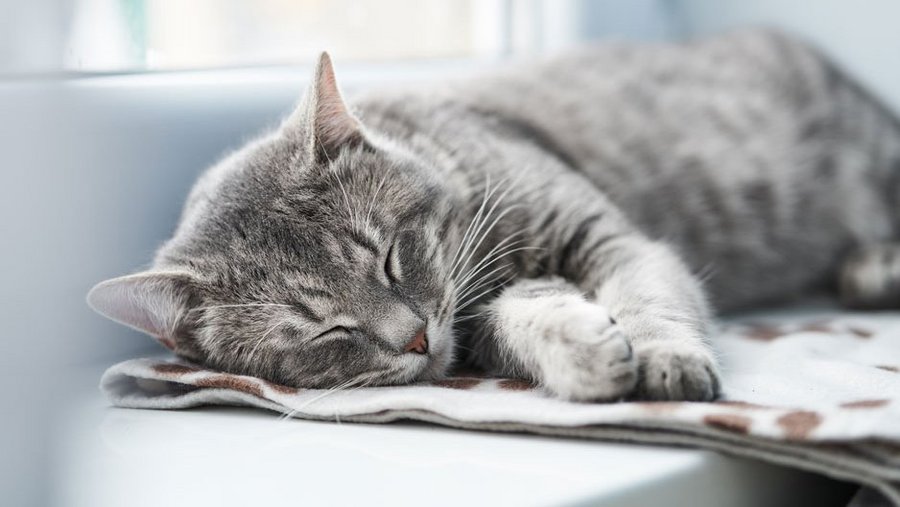
You have probably noticed that your cat repeatedly adopts typical sleeping positions. When snoozing, their posture patterns vary from lying on their side to lying upright, with a lowered or raised head revealing a lot about their state of mind. And what about the many funny pictures that show cats in all kinds of contortions? These say one thing above all: It's a young specimen that has simply been overcome by sleep after playing and romping around. Small cats can relax deeply anytime and anywhere, they have not yet had any bad experiences. This changes later on. Then you can tell from the typical sleeping postures whether your cat is slumbering relaxed or is somehow unhappy.
The classic: the curled-up cat
The most original of all sleeping positions! Here your cat lies on its side and pulls its head and legs together, its tail is often wrapped around its body. The front and hind legs touch each other or lie crossed. This is the posture that wild cats and their tame relatives have adopted for thousands of years. The cat makes itself small and thus offers little protection from the wind and weather. You don't need to worry about this: the cat doesn't freeze, it simply sleeps in one of its most natural sleeping positions.
Typical sleeping position: half curled up
Here your cat is also lying on its side. The front legs are slightly tucked up, tail and hind legs are stretched out. Sometimes the face is covered by a paw. The head is lying on the floor - a sign that the velvet paw is actually asleep. A cat in this position feels safe and is deeply relaxed. And wants one thing above all else: not to be disturbed.
Ready to escape: On all paws
This position is also part of your cat's standard repertoire. It sits on all paws, with its belly resting on them and its head raised. The front paws are either folded in or retracted. In this position, the eyes are usually half open. Many cat owners consider this position to be a particularly contented posture, but the opposite is actually the case. The raised head indicates: This cat is not really sleeping, even if it keeps its eyes closed. It is dozing, but is ready to escape at any time. This posture is often also a sign that your cat is unhappy about something. If your pet turns away from you, it is definitely annoyed by something. If you notice that your furry friend adopts this position very often, this may be a sign of pain. You should then check whether your cat is eating and drinking normally and going to the toilet regularly.
A good compromise: lying on its side on its chest
A variation of the upright resting position is the semi-upright position. The cat's abdomen is lying on its side, the hind legs are stretched out. The chest and head are upright and the paws are "crossed". In this position, your pet is much more relaxed than when lying upright. Your cat can recharge its batteries and relieve its lungs, but still has full control.
Particularly restful: lying on its side
If your cat lies on its side with its head down and its legs loosely stretched out, it will have a particularly restful sleep. This position is particularly comfortable for them. She feels safe, nothing worries her. At this moment, she thoroughly recharges her batteries and is fit for the next activities after this deep relaxation.
Phew, that's warm: lying stretched out
You'll see this position particularly often in summer: your cat lies on its side and stretches out for a long time. In this way, it tries to get as much of the cool ground as possible and release as much heat as possible. If you see your furry friend lying like this, it's time to unpack the self-cooling mat or open the door to a particularly cool room.
Deeply relaxed: On the back
Few cats present themselves like this. For you, it's a reason to be happy, because your cat feels completely at ease and trusts you completely. The fact that it shows its belly, its most vulnerable spot, tells you that it feels completely safe with you. If your cat is awake, you can carefully try out whether it will let you cuddle it. However, if it has fallen asleep, you should not disturb it under any circumstances.
What type is your cat? The very relaxed one or the more alert one? How often does it sleep in which position? If it adopts the relaxed positions particularly often, then you can be happy with yourself and the overall situation. How much your cat sleeps is also important. It should be at least 13 hours, the average is 16 hours. If she doesn't get any rest, then you have the opportunity to improve the situation. She may want a raised sleeping area, or she may need a particularly undisturbed resting place. your careful observation may even help you to detect illnesses. It's worth keeping an eye on your pet's resting habits. Because as you can see, your velvet paw is always talking to you. Even when they sleep.