

Guide dog knowledge
Show all answers
Hide all answers
-
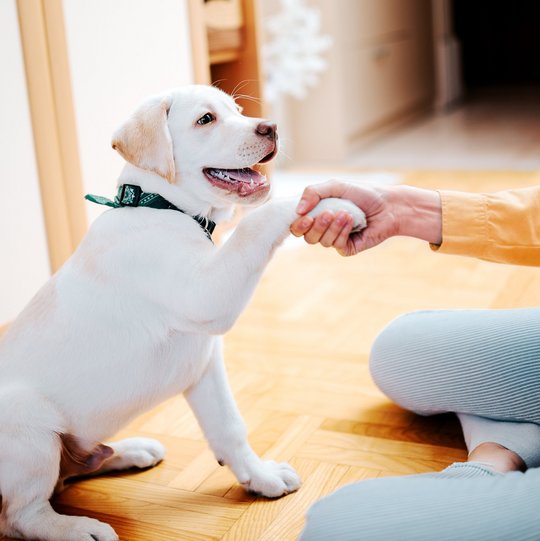
What do I need to bear in mind when training my dog?
If you understand the behavior of a dog, you can easily make friends with your four-legged friend.
The following basic rules should be observed when training your dog:
- A young dog does not yet know its limits. If it tests and exceeds them, consistency is particularly important.
- The dog must learn to accept its mistress or master as the higher-ranking member of its "pack".
- The commands should be short and easy to remember: "Sit", "Come" and "Off".
- A dog cannot concentrate for long periods of time, so this should be taken into account during training and only practiced in short intervals.
- Praise and reward your dog when he has done something right, e.g. with tasty snacks from Vitakraft.
- Training should be fun for the dog, so it is best to always end it with an exercise or game that has already been learned.
How to house train your puppy
After eating, sleeping and playing, you should take your puppy outside quickly and show him where he can do his "business". Hurry if the young dog runs around restlessly or turns on its own axis. Lots of praise and a reward (e.g. Vitakraft Beef Stick®) encourage him to become house-trained quickly.
Getting used to the collar and lead
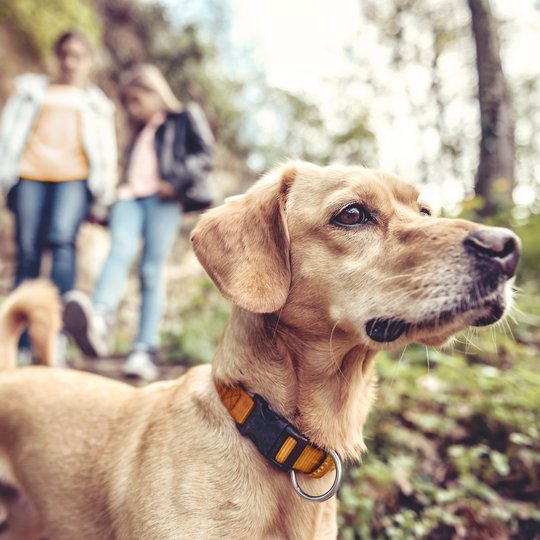
Even before the first walk, the young dog is accustomed to the collar and lead at home. In the beginning, it is sufficient for him to wear the collar for a short time under supervision. Praise and rewards also help here.
Train with patience and love
Dogs particularly like to learn when they notice that their owner is pleased with their behavior - that's why prompt praise and possibly a reward are essential when training a dog. Vitakraft has therefore developed a varied range of species-appropriate snacks in handy pack sizes. With valuable nutrients - and lots of flavor!
-
How do I feed my dog properly?
The basics of nutrition
Species-appropriate nutrition is important to enable dogs to lead a healthy and happy life. The composition of Vitakraft products is therefore based on the latest scientific findings and is geared towards the natural needs of wolves and wild dogs.
As descendants of the wolf, our dogs still have a lot of wolf nature in them: they are hunters and carnivores. However, it would be more accurate to describe them as "predominantly carnivorous" - because both wolves and wild dogs also eat plant matter. In some cases, they consume these directly, e.g. in the form of berries or grass. However, some plant components are also eaten via the prey, e.g. with the stomach contents.The types of food
Staple food:
A staple food covers the dog's basic nutritional requirements.Snacks:
These treats are ideal as rewards and are a valuable aid in education and training. At the same time, a snack should also be species-appropriate and healthy. It can even fulfill an additional task, e.g. support dental care as with Dental 3in1 Whether hypoallergenic, grain-free or low-fat: the Vitakraft range also includes numerous treats for special needs.Chews:
Chews are the ideal combination of activity and dental care. In addition to the natural chews, the cleverly wrapped DELI CHEWS chew bones are also highly recommended.Food supplements:
Food supplements serve to strengthen and build up the body. They cover special requirements, e.g. during growth, after illness, for particularly active dogs, during pregnancy, etc.Feeding tips
- Feed adult dogs twice a day, puppies three times a day
- Feed at fixed times
- Serve food at room temperature
- Do not disturb the dog during feeding
- Remove perishable food leftovers immediately
- Wash out bowls thoroughly after each meal
- Always offer fresh drinking water
- Dental care snacks such as Dental 3in1 after the meal
-
What do I need to consider when keeping and caring for my dog?
As a dog owner, you take on a lot of responsibility, because dogs are not solitary animals, but pack animals that depend on their humans as a substitute pack. Some breeds have special talents or make special demands. However, many points that need to be considered when keeping a dog apply to all breeds, e.g. sufficient exercise and regular health checks.
Grooming
Short-haired dogs are groomed once a week with a brush, whereas long-haired animals need intensive daily grooming.
Dogs want to smell like dogs and sometimes roll around in things that we humans find highly unpleasant. It is best to use a mild, special dog shampoo, e.g. Bello® Shampoo from Vitakraft with vitamins and proteins, to bathe or shower your scruffy dog.Paws and claws
If the dog rarely walks on hard surfaces, the claws can become too long. They then need to be trimmed from time to time - the vet will be happy to help. Paw pads are sensitive to snow, ice and road salt. In winter, they must therefore be checked daily and rinsed if necessary.
Teeth
Chewing bones from the Vitakraft range are a good dental care aid for dogs. We also recommend dental care sticks with special active ingredients such as Dental 3in1.
Ears
Once a week, the dog's ears should be carefully cleaned with a dry cloth. This is particularly important for long-eared dogs.
A clean sleeping and eating area
Food and water bowls should be washed out with hot water after every meal or at least once a day. The sleeping or basket blanket should also be shaken out daily and washed regularly.
-
Which dog suits me & what do I need?
Noble pedigree dog or cheeky mongrel? Every dog has its own character. Ultimately, personal preferences determine which dog you choose. Belonging to a breed is not always the deciding factor - sometimes it is simply "love at first sight".
Tips for buying
If you are looking for a dog, there are various options. For example, you can buy a pedigree dog from a responsible breeder. You can get addresses from the relevant breeders' associations. But there are also always dogs waiting for a loving new home at animal shelters.
You can recognize a healthy dog by
- the exuberant and lively behavior
- a thick coat
- pale-colored gums (redness can indicate inflammation)
- a wet, cold nose (but free of discharge or mucus)
- clear eyes
- clean ears
Checklist for the initial equipment
To feel really comfortable, the dog needs some accessories as well as food:
- A cozy place reserved just for him, with a sleeping basket or blanket
- Food bowls, e.g. made of stainless steel, and a drinking bowl
- Toys to keep him occupied, e.g. a ball, a play rope or rings
- Leash, collar or harness for the walk
- Comb and brush for grooming
- Chews to keep them occupied and to care for their teeth and dentures
- Staple food for the daily diet
- Snacks as a reward, such as Vitakraft Beef Stick® or Treaties® Bits.
Our offer for your dog
Dog sausage, dog snacks, treats and supplies
Discover our offer for your dog
Dog sausage, dog snacks, treats and supplies