

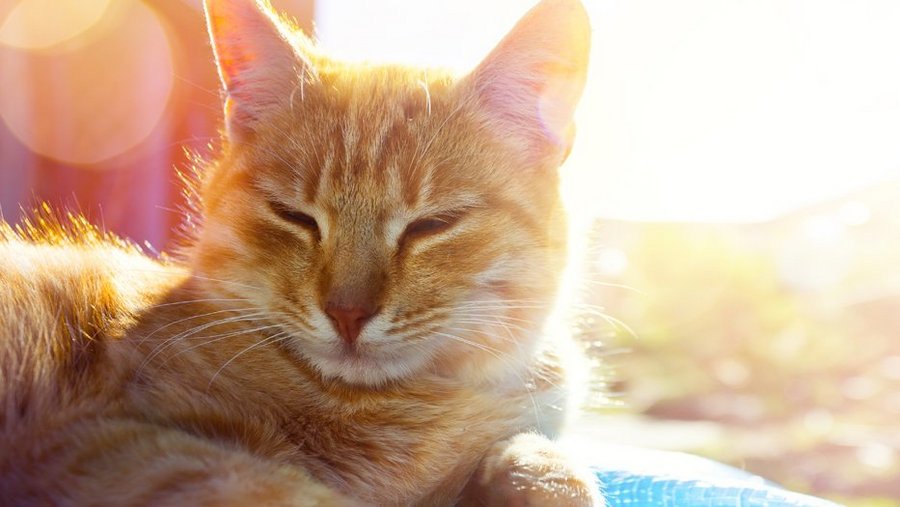
Water is known to be a rare commodity in the desert and is not "wasted" through the skin. Even if your cat never gets wet with sweat, it does have sweat glands. For example, on the back, the corners of the mouth, the teats and the paws. However, these glands do not produce visible sweat. Instead, the so-called apocrine glands on the back produce a skin-protecting substance. Eccrine glands at the corners of the mouth, the teats and especially the paws are used for communication. You have probably noticed that your cat leaves delicate paw prints on smooth surfaces. Other cats then know "someone has already been here". Scratching trees is also a form of communication, where your cat leaves particularly intense scent marks. So the glands are not good for sweating, but for many other things. But how does your velvet paw regulate its body temperature?
Adapt its behavior to the heat.
The first thing your cat will do in the heat is to find a shady spot and take a siesta. It will stretch out as long as possible to release as much temperature as possible into the cool environment. It shifts its activity phase to the night. If this is not enough, it will lick its fur to provide evaporative cooling.
Putting the body into summer mode.
Cats also have a number of fascinating bodily functions to combat the heat - and conversely the cold.
Change of coat
The typical change of coat takes place in spring and fall. This means that your velvet paw adapts to the different temperature conditions. In midsummer and during longer periods of heat, they shed additional fur.
Skin temperature
Cats can actively change their skin temperature. In winter, they lower their skin temperature in order to lose less heat to the environment. In the case of internal heat stress, for example after hunting, the skin temperature is raised in order to emit heat radiation. This mechanism is also activated by external heat stress, i.e. also in summer heat. Or when your cat snuggles up in front of the stove in winter and you wonder how he can stand it.
Miracle net
To protect their brains from overheating, cats have a very special anatomical adaptation: the so-called miracle net, technically known as the "rete mirabile". This is a network of blood vessels in the head area that functions like a heat exchanger. If the brain temperature rises, for example due to physical exertion or heat, cool blood is transported from the nasal epithelium to the cerebral arteries to dissipate heat. This mechanism also works in the opposite direction. If the brain temperature is low - due to hypothermia, for example - no heat is dissipated from the brain.
Panting and increased paw sweating.
Cats also pant to combat the heat. In this case, however, you should give your velvet paw a chance to cool down. The same applies to extreme perspiration on the paws. If your pet leaves clearly visible paw prints on the floor, you need to intervene. You can find out how to get your cat through the summer heat here .