

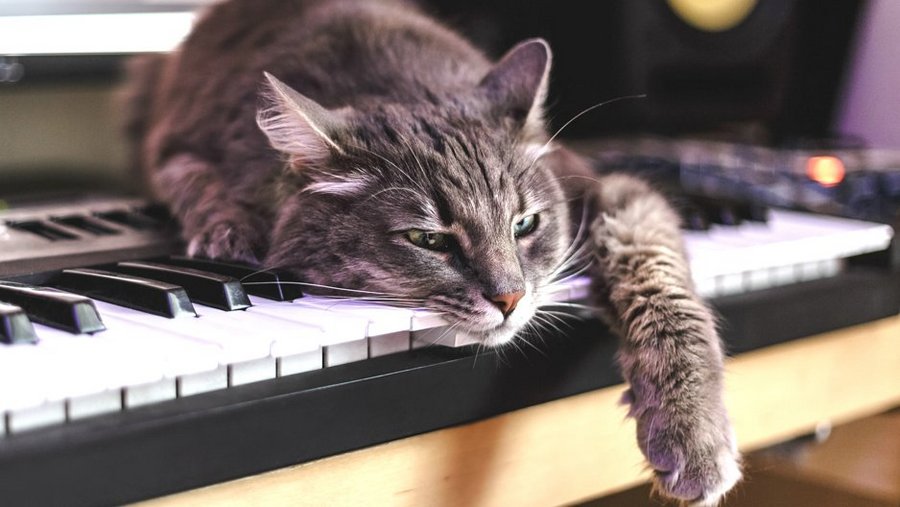
It is common knowledge that cats hear better than humans. Our velvet paws not only perceive sounds that are outside the range of human perception due to their low volume. They also detect other frequencies. While the human ear only perceives vibrations in the range between 16 and 20 kilohertz, cats can hear in the ultrasonic range up to 60 kilohertz. They not only pick up the vibrations with their ears, but also via their paws and tactile hairs.
Classical music for cats. Love at first sound?
Scientists have discovered that cows respond particularly well to classical music. They relax to Mozart and give more milk. With cats, research comes to different conclusions. In one study, our felines did not react at all to classical music; in another, cats under anesthesia for an operation calmed down noticeably to classical music and soft pop music, whereas AC/DC made their pulse beat faster. Many vets and cat owners are convinced, even without scientific evidence, that chill-out music, calm classical compositions or relaxation CDs calm our velvet paws. One thing is certain: if we listen to music that makes us feel more relaxed, our four-legged friends - as in many other situations - take their cue from their humans.
Sounds that cats love.
But are there perhaps also sounds that touch cats directly? Yes, there are. The American cellist and orchestral musician David Teie, together with scientists, has investigated which sounds are particularly appealing to cats. The result was that our velvet paws generally prefer to hear sounds that are an octave higher than our usual pitches in "human" music. In Teie's experience, violin, cello and keyboards are suitable instruments for producing cat music. Cats also seem to have a different preference than their owners when it comes to the number of beats. We humans can relax best with music at 60 to 70 beats per minute (bpm) - this corresponds to our heartbeat. Cats, on the other hand, love a beat rate of over 1,000 bpm, which corresponds to the beat of their purr. Finally, Teie found another sound that is pure music to the ears of cats: the sound of them sucking on their mother's teats. The musician translated his findings into a composition entitled "Music for Cats". So that humans could also tolerate this "cat music", he added sounds that do not disturb cats and are pleasant for their owners. And lo and behold: in a scientific study, 77 percent of the four-legged test subjects reacted positively or even relaxed to the work created especially for them.
Conclusion: cats prefer it gentle
It's clear to everyone that cats flee when they hear loud, noisy music, whether it's heavy metal, techno or jazz. Whether your velvet paw relaxes to soft classical compositions or chill-out music - for example together with you on the sofa - is something you simply have to try out. If you play an instrument such as the violin or keyboard, you can test whether you can please your cat with certain sounds. In any case, it is important that you also like the music. Because your cat will only calm down with a happy person.