

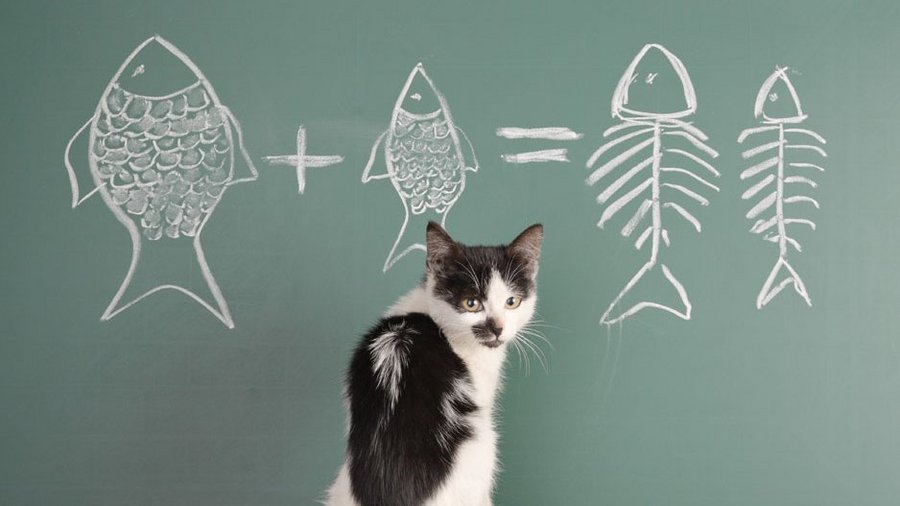
Intelligence tests with cats are not very popular among researchers. While the cognitive abilities of dogs, pigs, birds and monkeys have been well studied, there are only a few studies on cats. Why? Quite simply, cats are not very motivated to take part in experiments. This is not due to a lack of IQ, but simply to the nature of cats. As we know today, cats are not loners, but live in loose social groups. However, they go hunting alone. That is why cats are so "uncooperative": it is simply in their nature not to cooperate with others. However, this is precisely what we humans perceive as particularly pleasing. Researchers consider it an important reference for intelligent behavior. But there are many other characteristics that prove the intelligence of cats. Also in a scientific sense.
Intelligent imitation
Learning by imitation is considered an important indicator of intelligence in behavioral research. For cats, this characteristic is essential for survival. Because they learn how to hunt from their mother by imitation. Or how to use the litter tray. In the wild, the mother cat teaches her kittens to bury their droppings. This means there are fewer traces of scent that could attract predators. Adult cats also copy the behavior of their "roommates". For example, opening doors. Other cats can turn on taps. There are countless examples of this on the Internet.
Memory as an intelligence trait
Cats have an amazingly good memory. Perhaps you have tried to hide treats from your cat in a cupboard? Only to discover days later that the hiding place has been emptied? Cats have been shown to remember a place where they find something even months later. I'm sure you've heard stories of cats reappearing at their original home many weeks after a move. It is believed that cats are astronauts, similar to migratory birds. With the help of the position of the sun, their internal clock and presumably orientation to magnetic fields, they find their way back to familiar places. Even if these are hundreds of kilometers away.
Intelligent handling of cause and effect
However, cats also seem to have a certain understanding of the laws of physics, for example the principle of cause and effect. If a cup makes a noise when it is shaken, then there must be something inside. And this something falls out when the container is turned upside down. This is exactly what Japanese scientists tested. Cats were not very impressed when they heard a rattling noise and something rolled out when the cup was turned upside down. However, they seemed irritated when turning the cup upside down had no effect. Or the shaking was noiseless and then an object tumbled out. Incidentally, this behavior is at the level of small children - which is considered a remarkable value in intelligence research with animals.
Interpreting gestures? Is intelligent.
Whether an animal can interpret gestures and signals is also a common factor for the IQ of a species in behavioral research. Can cats interpret a gesture - for example, pointing to a feeding place? They can! A study by a team of Hungarian researchers (who, incidentally, mainly research dogs) found that cats can indeed follow human gestures to find food.
Human, what should I do?
Do cats follow their owners' attitudes? You probably have a hunch, because in our tips you will read again and again that you should be calm and firm to give your cat a sense of security in unfamiliar situations. What you know from experience has also been proven in experiments. In order to scientifically investigate this so-called "social referencing", cats were confronted with a running fan to which streamers were also attached. A highly unpleasant situation for cats. The animals were brought into a room with their owner, the fan was switched on and the cat owner was asked to react either neutrally, frightened or relaxed. Around 80 percent of the cats looked back and forth between the fan and humans. Apparently they wanted to find out how they themselves should behave. If the cat owner looked frightened, the cats tended to move away from the fan and interact with their human. According to the scientists, the cats were possibly looking for security from their owners.
Communicating intelligently with "words"
Surely you know various sounds that your cat uses to tell you what it wants? For example, a gentle, pleading meow when it wants to go out the door? Or a more insistent one when it's really time for food. Scientists have counted around nine different types of vocalization in young cats and around 16 in adult animals. And now it gets really interesting: domestic cats have more different "words" than wild cats. So our house cats have probably also adapted to humans in the course of their domestication.
There are countless examples that suggest the intelligence of cats. The great curiosity of cats alone leaves no doubt that an alert mind lies dormant in these animals. And the fact that they learn tricks, know "their" name in a multi-cat household or know exactly when it is feeding time. Cat owners don't really need proof that their pets are smart. The fact that science is increasingly providing this is a nice bonus.