

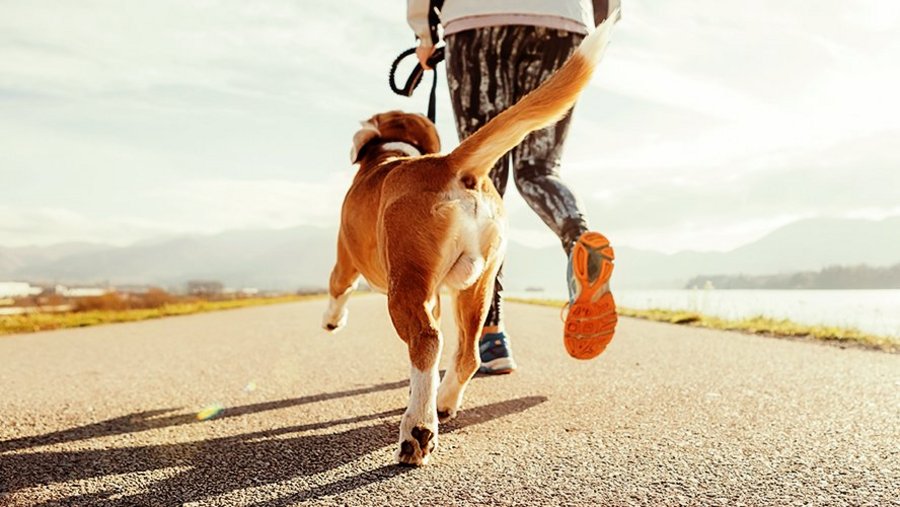
Before you set off with your dog, you should check a few things. Is your running partner old enough, i.e. fully grown? Only then will their bones and tendons be strong enough for the strain. Depending on the breed, growth is complete between seven and 24 months of age. No dog should start jogging before it is one year old.
Conversely, your dog should not be too old either. If you are unsure, ask your vet to confirm that your dog's joints and circulation are suitable for running. Furthermore, not every breed is made for jogging. Hunting and working dogs are generally well suited, but very large, heavy, short-snouted or short-legged breeds are less so. And finally: does your dog enjoy jogging? You can only find this out by trial and error.
In the beginning, it's "heel".
Before you start running with your dog, you should make sure that he walks safely at heel on a loose lead. Anything else will lead to stress or unpleasant incidents. You can also make some preparations when it comes to equipment. A special jogging leash allows you to have your hands free. Please note: the jogging leash should not be attached to a collar, and the flexible middle section ensures that small inconsistencies in speed are not immediately punished with a jerk. You may also want to treat your training partner to an extra "jogging harness". This can be a valuable indicator for you: if your dog crumbles as soon as you take it out, jogging is probably not his thing, but if he looks at you happily, you can be sure that your four-legged friend likes jogging. And when you put the harness on, he'll be in "training mode" straight away.
Step by step to your goal.
As with all training, you start gradually when jogging together. You can practise this before you throw on your sports gear and get started. For example, during your regular walk. Start by walking short sections at a brisk walk and then go one better at a slow trot. Then continue slowly. This way, your dog learns to adapt to changing walking speeds right from the start. To start with, you can introduce a special command when you change your speed. This will prevent your four-legged friend from falling into the lead every time you change to walking pace. If you practise these changes of pace long enough, your dog will become more and more attentive and adapt to your speed even without a command.
And off you go with the first running session.
Create the ideal conditions for the first real training session: These include a quiet time of day, a calm environment and a soft surface to protect joints and paws. You should also jog at a comfortable temperature, i.e. between 10 and 15 degrees. The last feed was at least two hours ago. Of course, your dog can warm up before you really get going. So first go for a walk, sniff around and do his business. So that your four-legged friend is not distracted by his needs during training. In future, this will be your checklist before every run. Then you can get started together. For now, short stages of a few minutes are enough. Then slowly extend them. You know your dog best and know what you can expect of him.
Fun instead of excitement
Fun is the most important part of your running training. You adapt to your dog, not the other way around. In concrete terms, this means that your four-legged friend determines the speed, duration and frequency of your training sessions. Keep a close eye on your pet and end the training session too early rather than too late. Some dogs keep running to please "their human", even if they don't really want to anymore. Praise your pet extensively and make sure they take regular breaks. Remember to take water for both of you on longer runs. And remember: animals get sore muscles too. You can recognize this when your four-legged friend struggles to stand up or walks a little stiffly. Then it's time to take it easy and go for relaxed walks. Four-legged training partners often like to be gently massaged at such times. Try it out to see if your dog is one of them. As soon as he is supple again, you can start the next round.