

Rabbits prefer to be quiet rather than loud.
Express themselves loudly? Not really a rabbit's thing. Of course, they can also growl threateningly, hiss or squeak anxiously. But if they don't like something, it's much more common for their hind paws to come into play, which are then used energetically. You've probably seen this before: you're stroking your rabbit and when it suddenly doesn't like it anymore, it kicks its hind paws wildly and tries to free itself. This is a clear sign that it's time to stop.
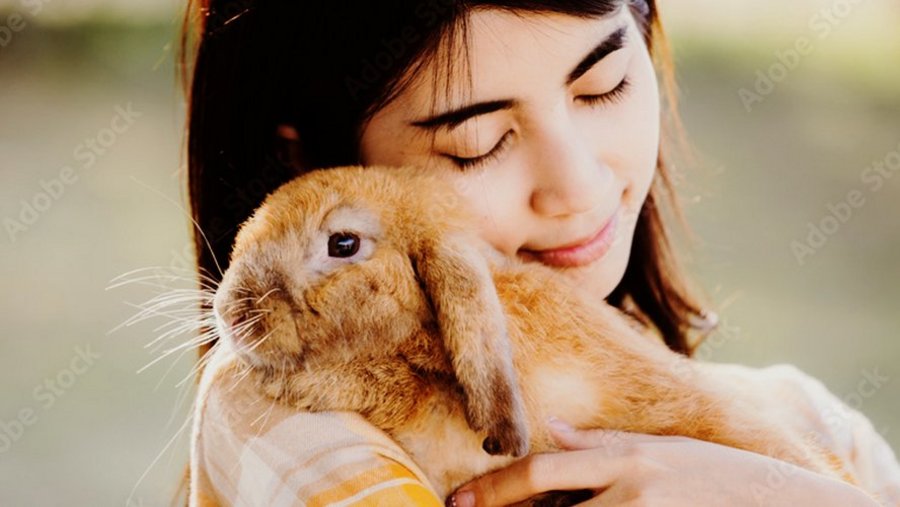
Rabbits love physical contact.
Unlike many other rodents, (dwarf) rabbits like physical contact with you. They are sociable creatures that like to live in groups. And since rabbits also groom each other, they also like to do this with their humans. They will nudge you with their snout and hold their head out. This is an unmistakable sign that your rabbit is now ready for a few strokes (which are the equivalent of grooming). If it also licks you, it is a social gesture and not, as is often mistakenly assumed, a sign of a lack of salt.
Rabbits show their contentment.
Your rabbit shows you a sign of complete relaxation when it lies on its back or stretches out all fours in a relaxed manner. If it also begins to "crunch" softly with its teeth, this is an expression of complete bliss. But beware: stronger teeth grinding can also be associated with pain or discomfort. When rabbits feel comfortable, they also like to roll around on the floor. Of course, your long-eared rabbit will be particularly happy if it can jump around and make big leaps. Especially outside in the summer enclosure, it's quite possible that you'll see them doing this often.
Rabbits like to do maneuvers.
What looks so cute is of course first and foremost to keep an eye out for enemies. This gives them an excellent view of everything. But your rabbit at home also likes to stand on its hind paws. This is because they are curious and want to know what is happening around them. Or when you hold out something tasty for it to eat. Then it will stand up and sniff it curiously.
Rabbits also talk with their ears.
Wiggle their ears? Rabbits particularly like to do this. You can tell their mood from their ears - provided you have a rabbit with erect ears and not floppy ears (like a ram, for example). If your rabbit's ears are laid back, the exact position is important: If the ears lie relaxed backwards, then it is happy all round. However, extremely close-set ears can also express fear. This is usually accompanied by wide-open eyes. You will quickly recognize the difference. If your rabbit is curious about something, it will tilt its ears slightly forward. If the ears are moved forward or to the side, then it is particularly attentive. Also, when it hears a noise, the ears are aligned accordingly to locate the direction.