

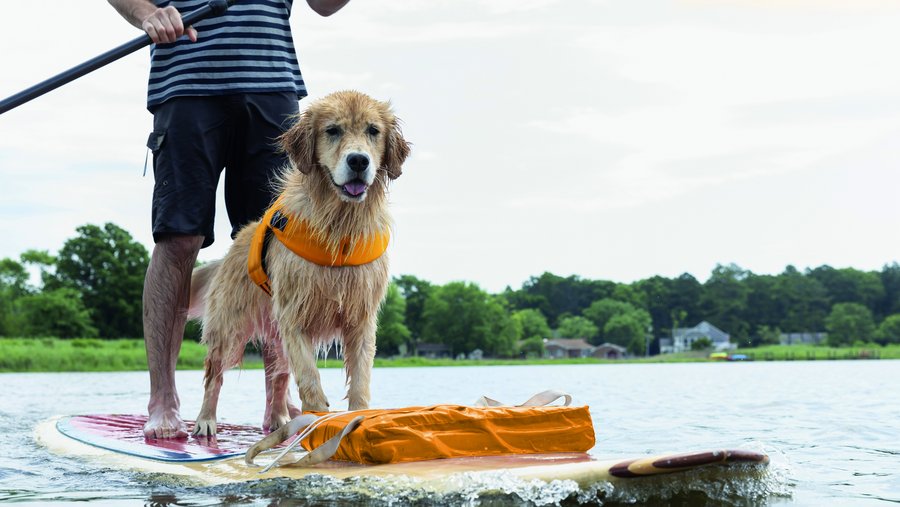
That's what counts: The right board.
If you already have a board or SUP, you should pay attention to the following: It must be able to support the total weight of you and your dog. For wet fur, add two to four kilos. Your board can carry that? Perfect. Then check whether it is covered with a continuous surface (deck pad). If not, you can retrofit this, or you can help yourself with a dog mat or a towel. Simply attach it to the board with straps. This will protect your dog from slipping and your board from unsightly scratches. Are you buying a new board? Then choose one that is as wide as possible. It will be more stable in the water. And your dog can turn around on it without stress. Fins provide additional stability, ideally your board should have three of them. It's always a good idea to test the board before you buy it. You can do this in various stores, rental stations and SUP schools. By the way: inflatable boards are not destroyed by dog claws.
Safety first: Life jackets for both.
Whether you wear a life jacket yourself is of course up to you. Wearing a life jacket is always safer. This also applies to your dog. Because although they can usually swim well, they can also quickly reach their limits over longer distances or in currents. The life jacket also has an extra advantage: a firm grip is all it takes to help your four-legged friend back onto the board. The life jacket should fit snugly but not too tightly and should not restrict your dog's freedom of movement. To find the right size, measure from the base of the neck to the beginning of the lumbar spine. Also measure the neck circumference and the chest circumference at the widest point. A harness will do at first. However, you should get your dog a life jacket at the latest when you set off on longer trips.
It's better to practise on your own first, then with your dog.
Before you get your dog used to the board, you should have mastered the most important skills yourself. Two beginners at once never make a good team. Because you can only get your dog across the water safely if you are confident yourself. And, above all, make him feel safe. You don't have to be a professional, but you should be able to master the following basic skills blindfolded: Getting on and off the board in the water, riding straight ahead while standing, turning and stopping. Until you have mastered these skills (if you haven't already), you can get your dog used to the board on land.
Getting used to the board: dry training.
First, let your dog get to know the board. You can place it in the living room or garden, for example. Then practise stepping on the board with your best friend and do exercises with him. Sit, down, stay and tricks, if you like. The next step is to get your dog used to balancing. To do this, get one or two friends to help you. They take the board at both ends and lift it slightly. You do exercises with your dog again while your helpers move the board slightly. Your dog is already learning that he only leaves the board when you allow him to. Because in the water, this is a tippy moment where you could both easily go swimming. Only when your dog can do all this safely and calmly can you get on the water.
Off to the water: the first time.
You are ready. And go into the water together for the first time. Choose the shallow water zone of a calm body of water. Preferably on a day when there is as little activity as possible. Then let your dog come up from the shore. You sit on the board. This way, you can keep it stable and don't have to climb up after it, which could unsettle your four-legged friend. Depending on your pet's character, this exercise may be the end of the first day. If your dog is braver, you can ask him to sit, down and stay. Gradually, you will get your best friend used to movement, the first paddle strokes along the shore, kneeling and standing and carefully moving away from the shore. What you should prepare for: If your four-legged friend changes position on the board, you need to compensate for this. This means leaving your usual position in the middle between the handles and sliding further forward, backwards or slightly to the side. If your dog's legs start to tremble when standing, there's no need to worry. But it's high time for a break. A favor you should do for both of you: Practice capsizing! Because sooner or later it will happen. It's good if you already know what to do in an emergency.
Once you are safe on the board with your dog, you can extend your outings further and further, right up to day trips. This will not only improve your fitness, but also your relationship.