

Tip 1: Give your hamster space
Despite their small size, hamsters need plenty of room to run around. The typical hamster cage that is usually used is definitely too small for their great urge to move. A hamster in the wild travels several kilometers a day to collect enough food in its cheek pouches and then bring it back to its den. An instinct that your hamster still has today. Ideally, you should build or buy a rodentarium for your hamster - a mixture of cage and terrarium. With high, transparent walls made of real glass or acrylic, you can watch the little animal digging, burrowing and digging tunnels. The enclosure should be 100 x 50 x 50 cm in any case, and preferably much larger. Also important: good ventilation and a thick, diggable layer of soil, which should be at least 20 centimetres high. Fill it with a mixture of small animal bedding, hay and straw so that tunnels and burrows can be dug and do not collapse again immediately. Your hamster is also a little Luis Trenker and needs plenty of room to climb. So give him plenty of climbing opportunities with ladders, bridges, stacked boxes, self-built stairs, etc. He can climb these as he pleases. He can climb up and down these as he pleases and is therefore well occupied.
Tip 2: Extra free run for your hamster
It's especially great if you offer your hamster a free run outside the cage. You can mark out an area with wooden boards, place a large tub with sand for "bathing", cardboard rolls as a tunnel, willow balls etc. in it. Small houses as retreats are also popular. There are no limits to your creativity as to what your hamster might like. A real activity wonder for your agile hamster is a home-made or bought wooden maze, equipped with small obstacles and lots of tasty objects (e.g. small Vitakraft® snacks and drops) for him to discover. A complete room offers the hamster plenty of free run, but also needs to be made hamster-proof with great care. Especially when it comes to sockets, sharp objects and other small hazards. They also like to nibble on furniture, cushions and books. If you don't want this, a kind of cordoned-off free-range zone is definitely the better solution. Whichever free-range area you choose: Your hamster should definitely be hand-tamed beforehand so that it doesn't turn into stress for both you and him when you return him to the cage.
Tip 3: Daily jogging laps in the hamster wheel
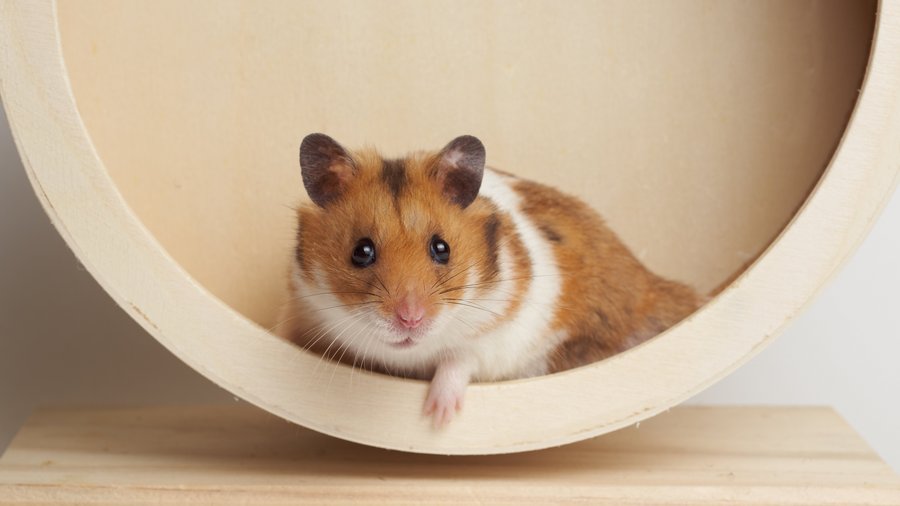
It looks like hard work - and it is: running in the hamster wheel. Here, the little athlete can really step on the gas when he feels like it. At the same time, the wheel also helps in stressful situations. For example, if he is frightened by something. As far as hamster wheels are concerned, there are countless models on the market - but what does an ideal wheel actually look like? As with all other objects that your hamster comes into contact with, it should be rodent-resistant and preferably made of wood rather than plastic. This will ensure that no plastic particles get into your pet's stomach when they gnaw on it. Running wheels made of mesh are not recommended. Claws and feet can easily get tangled up here - increasing the risk of injury. As far as the size of the running wheel is concerned, you should make sure it has a diameter of at least 25 centimeters. This ensures that your hamster can move freely in the wheel with a straight back. The back wall - like the actual running surface - should also be closed.
If you provide your hamster with a large cage, a free run with lots of discoveries and a hamster-friendly running wheel, then one thing is for sure: your hamster will be happy to accept it and enjoy it to the full. For a happy, active life for your little companion.