

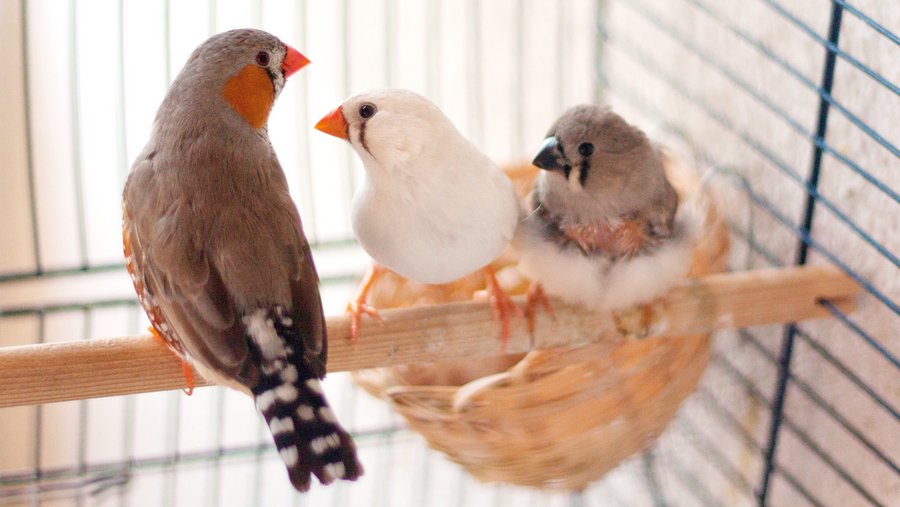
Zebra finches love one thing above all: company. That's why you should ideally keep a small group. Two to three pairs is a good size. Or even more if you can offer more space. The most comfortable accommodation is an aviary about two meters long. Here you can accommodate up to five pairs. If you allow your chicks to fly freely every day, they will also be happy in a spacious cage. Calculate a minimum area of 80 x 60 x 40 centimetres per pair. When choosing your bird house, make sure it has a rectangular layout. This will give your birds a long side to fly over.
The basics: beautiful living for zebra finches
In addition to food and water bowls, the basic equipment includes suitable bedding, for example bird sand or hemp litter, as well as a bathing house. Plus as many perches as possible. You are welcome to use natural branches such as fruit trees, beech or hazel. Make sure to offer perches of different thicknesses. If in doubt, it's better to make them too thick than too thin so that your birds' claws are always resting on the wood. This will ensure healthy bird feet. What zebra finches should not be without are sleeping nests or boxes, at least one per pair. Each pair then chooses a nest, which they pad elaborately and go to sleep in at night.
Cage and placement: a place in the sun
Zebra finches feel most comfortable when one or more sides of their housing are closed. If your bird house has no closed sides, place the cage against a wall or, even better, in a corner. An elevated position is ideal so that your pets always have an overview. Your pet's home should also be by a window if possible. They not only enjoy the light, they also need it: the UV radiation ensures healthy feathers and strengthens the immune system. Ideally, you should give your zebra finches a special UV lamp with a dimmer for the short winter days. Because the little Australians want at least ten, preferably 14 hours of brightness every day. The dimmer ensures that it doesn't suddenly get light or dark, but that your pets experience a natural twilight.
All-round fitness - with the right diet
Zebra finches feed mainly on seeds such as grass seed and millet. You can get the perfect mix with our Vitakraft® Exotic Menu. In addition, your birds should always have a clean bowl of bird sand available, as well as grit, a cuttlefish shell or crushed eggshells as a source of calcium. They love foxtail millet as a treat, and it is also a nice activity for your birds to pick the grains out of the panicle. Regular gifts of greens, such as lettuce, dandelion, chickweed or shepherd's purse, as well as fruit and vegetables round off your zebra finch's diet.
Variety is half the (bird's) life
Daily free flight gives your zebra finches plenty of variety. Flying not only strengthens their muscles, but also their immune system. Before the first free flight, make the room bird-proof. Any cracks and crevices in which your exotic birds could disappear can be sealed with slats, for example. You should also remove any harmful flowers and houseplants, such as carnations, primroses, violets or poinsettias. Make sure there are enough places to sit near the cage. Especially at the beginning, your pet may not be in good enough shape to walk long distances. For the time your finches spend in their home, you also have plenty of opportunities to provide variety. For example, with plenty of nesting material, as your birds love to mend their nests. For example, short cut hay or handkerchiefs plucked into small pieces are suitable. You can find more ideas on how to make your bird house more interesting here.
The thing with the offspring
There is a good reason why your pets love building their nests. For zebra finches, raising offspring is the greatest happiness on earth. Of course, you can prevent breeding by not providing nests. Or by regularly replacing the eggs with plastic hatching eggs. Sooner or later, however, your zebra finches will outsmart you. One thing is clear: for these little guys, rearing young is simply part of the job. So it's best to think about whether you can live with this before you buy them. And where you will keep the offspring. Some pet stores are happy to take offspring from hobby breeders.
Good to know: unlike budgerigars, zebra finches do not become tame. They more than make up for this with their lively nature, their constant hustle and bustle and their pronounced social behavior. Zebra finches are also extremely intelligent. This is why brain researchers use them as a model for their studies. So you can be sure: You'll never be bored with zebra finches in the house.